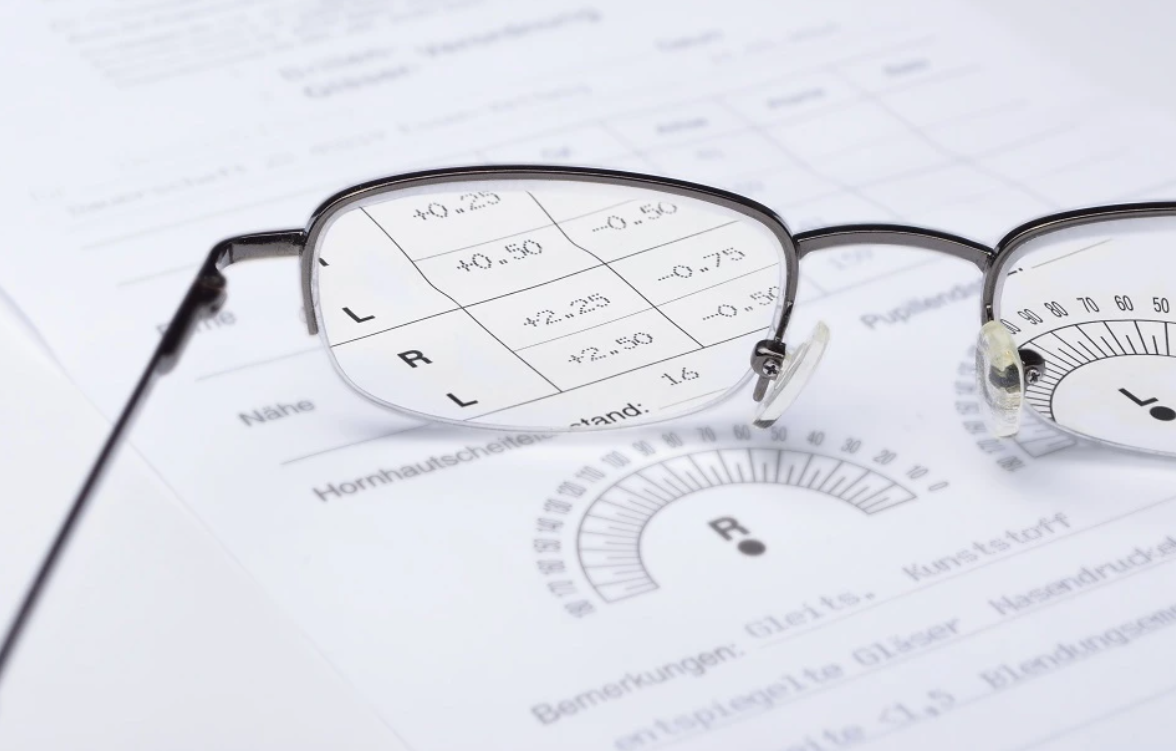

If you’ve ever looked at your glasses prescription and thought, “What do all these letters and numbers mean?” you’re not alone.
The good news is that your prescription is not a secret code. It’s simply a set of measurements that help your lenses make your vision clear and comfortable.
This guide will show you how to read a glasses prescription in plain language, including what common terms like SPH, CYL, AXIS, OD, OS, and ADD actually mean. We’ll also explain why pupillary distance (PD) matters and how often prescriptions typically change.
Whether you live in Hartland, Howell, Brighton, Pinckney, and nearby Livingston County communities, this blog will help you feel more confident the next time you get an updated prescription or shop for new glasses.
What do OD and OS mean on a glasses prescription?
One of the first confusing things patients notice is that their prescription is split into two rows labeled OD and OS.
Here’s what those mean:
- OD = Right eye
- OS = Left eye
- OU (sometimes included) = Both eyes
These terms come from Latin:
- OD is short for
oculus dexter (right eye)
- OS is short for
oculus sinister (left eye)
- OU is short for
oculus uterque (both eyes)
So when you see numbers listed under OD and OS, those are the measurements for each eye.
Why each eye has its own numbers
Most people don’t have identical vision in both eyes. Even a small difference can matter for comfort, especially with:
- Reading
- Screen time
- Night driving
- Headaches related to eye strain
Your prescription is tailored to help both eyes work together clearly, not just “get close enough.”
What do SPH, CYL, and AXIS mean?
If you’ve been wondering why prescriptions look so technical, it’s because they use shorthand for a few key measurements. These are the terms patients ask about most.
SPH (Sphere)
SPH is the main power of your prescription. It corrects either:
- Nearsightedness (you see up close better than far away)
- Farsightedness (you struggle with near tasks, or sometimes distance too)
SPH is written as a number with either a plus or minus sign:
- A
minus sign (-) usually means you are
nearsighted
- A
plus sign (+) usually means you are
farsighted
Examples:
- SPH -2.00 means you need help seeing clearly at a distance
- SPH +1.50 means your eye needs help focusing, often for near vision (or both)
CYL (Cylinder)
CYL refers to astigmatism, which happens when the eye has an uneven curve. Astigmatism can make vision look:
- Blurry
- Shadowed
- Stretched
- Slightly doubled
Astigmatism is common, and it doesn’t mean something is “wrong” with your eyes. It’s just a common shape difference that lenses can correct.
If CYL is blank, it usually means you don’t have measurable astigmatism correction in that eye.
AXIS
AXIS works together with CYL. It tells the lens where to place the astigmatism correction, based on how your eye is shaped.
AXIS is shown as a number between 1 and 180.
A simple way to think about it:
- CYL is how much astigmatism correction you need
- AXIS is where that correction is positioned in the lens
Even if the CYL number stays the same, a change in AXIS can still affect how clearly you see.

What does ADD mean, and why do some people have it?
If you see “ADD” on your prescription, it does not automatically mean something is wrong or that your eyesight is getting “bad.” It simply refers to extra magnifying power used for close-up vision.
ADD (Addition)
ADD is extra lens power added for near tasks like:
- Reading
- Phone use
- Sewing or crafts
- Close-up work
This is common for adults as they reach their 40s and beyond, when it becomes harder to focus up close.
Some patients notice this as:
- Holding reading material farther away
- Needing brighter light to read comfortably
- Eye fatigue during near work
ADD is often used for:
- Progressive lenses
- Bifocals
- Reading glasses (sometimes combined with distance correction)
“But my distance vision feels fine”
That’s very common. Someone can see well at a distance and still need a little near support.
Many people don’t notice it right away. They just feel like:
- Reading feels harder than it used to
- Their eyes get tired faster
- Screens feel more uncomfortable
A small change can make a big difference in comfort.

What is PD, and why does it matter for making glasses?
PD stands for pupillary distance, and it’s one of the most important parts of getting glasses that feel natural.
PD (Pupillary Distance)
PD is the distance (measured in millimeters) between the centers of your pupils. It helps ensure that your lenses are centered correctly in front of your eyes.
Even a small mismatch in PD can affect:
- Clarity
- Comfort
- Eye alignment and ease of focusing
- How quickly you adjust to new glasses
- Can create UN-prescribed power in the lens
When PD matters the most
PD is especially important for:
- Accuracy of a prescription, esp. in stronger RX
- Progressive lenses
- Multifocal lenses
- Specialty lens designs
If you’ve ever gotten new glasses and felt like something was “off” even though the prescription was correct, lens positioning can be a reason.
For patients in Hartland, Howell, Brighton, Pinckney, and nearby Livingston County communities, PD often comes up when ordering glasses online. PD is not part of the eye exam or prescription, it’s part of the manufacturing of the eyewear.
It’s next to impossible to get an accurate PD doing it yourself, since the little bit of eye movement and working distance changes the measurement.
If you are in need of your PD, your Optician can provide those measurements for a small fee.
This is paragraph text. Click it or hit the Manage Text button to change the font, color, size, format, and more. To set up site-wide paragraph and title styles, go to Site Theme.